
Accessing powerful graphics processing units (GPUs) plays a crucial role in various tasks, like cutting-edge machine learning, artificial intelligence (AI) work, creating stunning 3D visuals, and running complex scientific simulations.
Nowadays, cloud GPU services have become a smart choice to handle these computing needs without having to invest in expensive hardware. But with so many options out there, picking the right cloud GPU provider can feel a bit overwhelming.
They come in different shapes and sizes, with varying price tags and performance levels.
To help you make a savvy choice and ensure that your cloud GPU rental fits your specific requirements, it's essential to grasp the important things to think about and the various GPU models available.
In this detailed guide, we'll take you on a journey through the critical factors to consider when you're deciding on a cloud GPU rental service. We'll also dive into the nitty-gritty of different GPU types, like the NVIDIA A100, Tesla V100, and RTX 3090, so you can select the perfect one for your tasks.
Whether you're a data whiz, a programmer, or a creative genius, this guide will give you the know-how to make the most of cloud GPUs while keeping an eye on your wallet.
If you need more processing resources to ramp up your dense computations, then you might want to consider using cloud GPUs.
Let's kick things off by exploring some of the top cloud GPU providers out there.
The Best Cloud GPUs
- Latitude.sh
- OVH Cloud
- Paperspace
- Vultr
- Vast AI
- Gcore
- Lambda Labs
- Genesis Cloud
- Tensor Dock
- Microsoft Azure
- IBM Cloud
- FluidStack
- Leader GPU
- DataCrunch
- Runpod
- Google Cloud GPU
- Amazon AWS
- Jarvis Labs
- Linode
Latitude.sh
AI infrastructure for the companies of tomorrow
Deploy dedicated instances with NVIDIA's H100 GPUs in seconds. Start training your models with pre-configured deep learning tools like TensorFlow, PyTorch, and Jupyter.
Deploy high performance dedicated servers around the globe and manage them with a powerful dashboard, cloud native integrations, and a robust API.
Global edge locations
We operate every aspect of our points of presence, so you have a single partner for your global presence.
Carrier-grade network
We build and manage our network in all locations, which gives us more control of how we want it to work.
Custom builds
Deploy one or a thousand fully automated bare metal servers specific to your needs.
SAML Single Sign-On
Log in to Latitude.sh with your IAM. Our SAML integration supports the provisioning and de-provisioning of users.
Multi-factor Authentication
MFA is available as an additional security step for Email and OAuth-based logins.
OVH Cloud
OVH Cloud GPU Services make a compelling case with their high-quality offerings. OVH's strong commitment to technological advancement is evident in their use of the latest NVIDIA Tesla GPUs, ensuring users access the most advanced capabilities available.
Where OVH really shines is in its efficient cooling and power management solutions. It allows OVH to maintain high GPU performance without incurring excessive power usage, making their services more environmentally friendly. In addition, the efficient cooling solutions help prolong the GPU's life, ensuring users enjoy sustained high-level performance.
OVH offers robust customer support services, with a responsive and knowledgeable team ready to assist. This, coupled with the service's impressive uptime guarantees, makes OVH a reliable option for those seeking dependable cloud GPU services.
OVH Cloud is a major player in the global cloud computing scene, offering a diverse range of services, including dedicated servers, VPS (Virtual Private Servers), and cloud computing solutions. What sets them apart is their emphasis on GPU-powered instances, which can supercharge tasks like machine learning, 3D rendering, and large-scale simulations.
Features
Cost-Effective Pricing: OVH Cloud is known for its budget-friendly pricing, making it accessible to a wide range of users, from individuals to businesses.
Data Privacy: They take data privacy seriously, ensuring that your information is kept secure and private.
Versatility: Whether you need web hosting or high-performance computing, OVH Cloud has solutions to fit your needs.
Computational Power: Their GPU instances are designed for heavy lifting, offering impressive computational power for demanding tasks.
Global Reach: With data centers spread across the world, OVH Cloud ensures reliability and minimizes latency, which is especially important for international clients.
Pros
- Cost-effective pricing.
- Robust data privacy policies.
- Suitable for various needs from web hosting to high-performance computing.
- High computational power for machine learning, 3D rendering, and simulations.
- Global infrastructure with multiple data centers for reliability and reduced latency.
Cons
- Limited specialization compared to some other providers.
Buyers Guide
Over the years, huge improvements in graphics rendering, artificial intelligence, deep learning, and other areas that require a lot of computing power have led to much higher expectations for how fast, accurate, and clear an application should be.
The availability of powerful computer resources that can run the processes behind these applications in large numbers and for long periods has made these improvements possible.
For example, because there are more graphics in modern games, they need to have more storage space.
To improve the gaming experience, faster processing rates are required to keep up with the ever-increasing high-definition images and background processes.
We just need more computer power to do all the things that need to be done to keep up with today's complicated programs.
Central processing units (CPUs) and improvements in processor architecture that have led to even faster CPUs have given computers the computing power they need to do most of their jobs.
However, far quicker processing of denser processes was required, necessitating the development of technology that would open up new avenues for efficient and rapid dense computing. As a result, graphics processing units were created.
GPUs, or graphics processing units, are a type of microprocessor designed to expedite graphical rendering and other multitasking processes by making use of parallel processing and increased memory bandwidth.
Games, 3D imaging, crypto mining, video editing, and machine learning are just some of the applications that have made them indispensable. Incredibly dense calculations are a bottleneck for CPUs, but GPUs make short work of them.
Since deep learning's training phase is so demanding on system resources, GPUs excel where CPUs fall short. There are a lot of convolutional and dense operations, therefore this type of operation requires a lot of data points to analyze.
These include several matrix operations using tensors, weights, and layers and are typical of the massive amounts of data and deep networks required for deep learning applications.
For deep learning processes, GPUs are far superior to CPUs due to their capacity to conduct several tensor operations at once because of their many cores and to store a larger amount of data according to their high memory bandwidth.
In contrast, a low-end GPU may do a task that takes a powerful CPU 50 minutes to complete in under a minute.
Why Use Cloud GPUs?
While there are still many that prefer to keep their GPUs in-house, the data science industry as a whole has been increasingly using cloud-based GPU solutions. Installing, managing, maintaining, and upgrading a GPU locally may be time-consuming and costly.
n contrast, consumers may take advantage of the GPU instances offered by cloud platforms without worrying about the aforementioned technological tasks, all while paying reasonable service fees.
These systems manage the GPU infrastructure as a whole and supply all the services programmers need to use GPUs for computation.
When the technical tasks associated with managing local GPUs are removed, users are free to concentrate on their core competencies. This will help streamline company procedures and boost efficiency.
Using cloud-based GPUs has many advantages over deploying and maintaining hardware locally, including a reduction in administrative burden.
Using cloud GPU services can help smaller firms decrease the barrier to entry when it comes to constructing deep learning infrastructures by transforming the capital expenditures necessary to mount and operate such computing resources into an operating cost.
Additionally, cloud platforms provide benefits including data transfer, accessibility, integration, collaboration, control, storage, security, update, scalability, and support for efficient and stress-free computing.
It is perfectly reasonable that someone else supplies the ingredients, similar to a chef and his helpers so that you can concentrate on cooking the dish.
How do I get started with cloud GPUs?
As cloud platforms strive to make their services more accessible to a wider audience, they create user-friendly interfaces for cloud GPUs.
Selecting a cloud service is the first step in utilizing cloud GPUs. Identifying a platform that best fits your requirements requires doing some research into the features and capabilities of the many options available.
In this post, I will recommend the finest cloud GPU platforms as well as instances for deep learning workloads; however, you are encouraged to research alternative possibilities to discover the one that best suits your needs.
Once a platform is selected, the following step is to learn how to navigate its user interface and internal systems.
Here, repetition is the key to success. Almost all cloud services include extensive online resources for studying their ins and outs, such as blogs, training videos, and written documentation. The information here can help users out.
For a more comprehensive and efficient education and use of their services, some major platforms (including Amazon, IBM, Google, and Azure) provide formalized training and certification.
If you are just getting started with cloud computing and data science, I highly recommend getting started with Gradient Notebooks because of its free, limitless GPU access.
That will provide you with practical knowledge before you go on to more complex enterprise-level systems.
How do I choose a suitable platform and plan?
Choosing the best cloud GPU platform for your unique computing needs, whether personal or professional, can be a bit of a conundrum.
Considering the plethora of cloud services from which to choose, making a decision might seem like a Herculean task.
You should evaluate the cloud GPU platform's GPU instance specs, infrastructure, design, price, availability, and customer support before committing to using it for your deep learning operations.
Each situation calls for a different plan, one that takes into account factors like data volume, cost, and volume of labor.
Paperspace
In the realm of cloud GPU services, Paperspace shines brightly with its user-friendly approach, breaking down barriers to advanced computing and extending its reach to a wider audience.
Paperspace has earned its stripes among developers, data scientists, and AI enthusiasts for its simplicity when it comes to setting up and deploying GPU-powered virtual machines. It's like a virtual playground for tech enthusiasts!
For those deep into the world of machine learning and AI development, Paperspace offers a golden ticket. They provide pre-installed and finely tuned environments for various ML frameworks, saving precious time and headaches.
Creative professionals, including graphic designers and video editors, find solace in Paperspace's high-performance GPUs and rendering capabilities. It's a canvas for turning ideas into visual masterpieces.
Paperspace knows that one size doesn't fit all, so they offer flexible pricing models, including per-minute billing. This means it caters to both the lone wolves and the big corporate hawks, adapting to your needs.
Pros
- User-friendly and easy setup.
- A favorite among developers, data scientists, and AI enthusiasts.
- Pre-installed and configured environments for various ML frameworks.
- Ideal for creative professionals with its high-performance GPUs.
- Flexible pricing models, including per-minute billing.
Cons
- Might not provide the same level of customization as some other providers.
Vultr
Vultr distinguishes itself in the cloud computing market with its emphasis on simplicity and performance. They offer a wide array of cloud services, including high-performance GPU instances.
These services are particularly appealing to small and medium-sized businesses due to their ease of use, rapid deployment, and competitive pricing. Vultr’s GPU offerings are well-suited for a variety of applications, including AI and machine learning, video processing, and gaming servers.
Their global network of data centers helps in providing low-latency and reliable services across different geographies. Vultr also offers a straightforward and transparent pricing model, which helps businesses to predict and manage their cloud expenses effectively.
Pros
- Simple and rapid deployment.
- Competitive pricing.
- Suitable for small and medium-sized businesses.
- Good for AI, machine learning, video processing, and gaming.
- Global network of data centers for low-latency services.
Cons
- May lack some advanced features offered by larger competitors.
Vast AI
Vast AI is a unique and innovative player in the cloud GPU market, offering a decentralized cloud computing platform.
They connect clients with underutilized GPU resources from various sources, including both commercial providers and private individuals. This approach leads to potentially lower costs and a wide variety of available hardware. However, it can also result in more variability in terms of performance and reliability.
Vast AI is particularly attractive for clients looking for cost-effective solutions for intermittent or less critical GPU workloads, such as experimental AI projects, small-scale data processing, or individual research purposes.
Pros
- Potential for lower costs.
- Wide variety of available hardware.
- Cost-effective for intermittent or less critical GPU workloads.
- Suitable for experimental AI projects and individual research.
Conss
- More variability in performance and reliability due to decentralized resources.
G Core
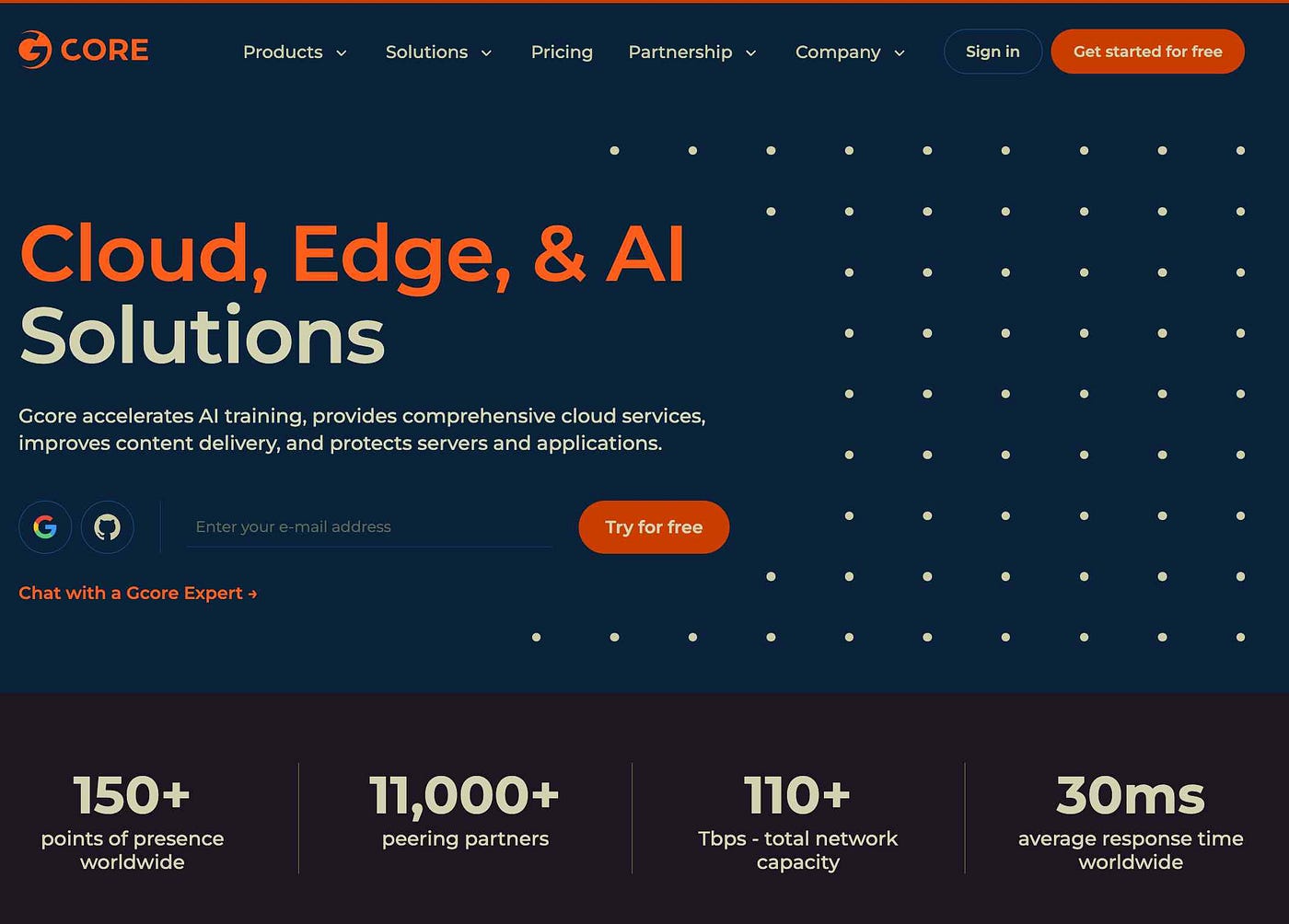
Gcore specializes in cloud and edge computing services, with a strong focus on solutions for the gaming and streaming industries.
Their GPU cloud services are designed to handle high-performance computing tasks, offering significant computational power for graphic-intensive applications. Gcore is recognized for its ability to deliver scalable and robust infrastructure, which is crucial for MMO gaming, VR applications, and real-time video processing.
They also provide global content delivery network (CDN) services, which complement their cloud offerings by ensuring high-speed data delivery and reduced latency for end-users across the globe.
Pros
- High-performance computing for graphic-intensive applications.
- Scalable and robust infrastructure.
- Global content delivery network (CDN) services.
- Suitable for MMO gaming, VR applications, and real-time video processing.
Cons
- May be less suitable for non-gaming or non-streaming workloads.
Lambda Labs
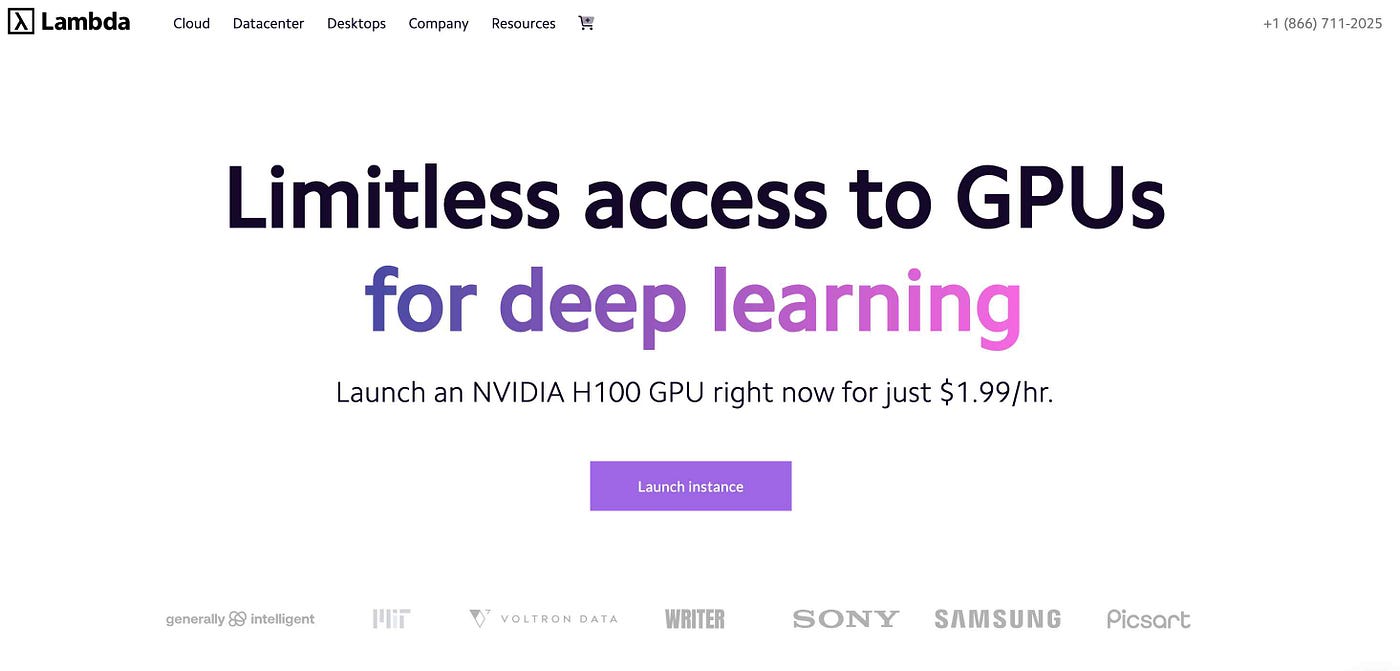
Lambda Labs is a company deeply focused on AI and machine learning, offering specialized GPU cloud instances for these purposes.
They are well-known in the AI research community for providing pre-configured environments with popular AI frameworks, saving valuable setup time for data scientists and researchers. Lambda Labs’ offerings are optimized for deep learning, featuring high-end GPUs and large memory capacities.
Their clients include academic institutions, AI startups, and large enterprises working on complex AI models and datasets. In addition to cloud services, Lambda Labs also provides dedicated hardware for AI research, further demonstrating their commitment to this field.
Pros
- Pre-configured environments with popular AI frameworks.
- Optimized for deep learning with high-end GPUs and large memory capacities.
- Suitable for AI research, academic institutions, and startups.
Cons
- May have specialized focus and pricing geared towards AI research.
Genesis Cloud
Genesis Cloud provides GPU cloud solutions that strike a balance between affordability and performance.
Their services are particularly tailored towards startups, small to medium-sized businesses, and academic researchers working in the fields of AI, machine learning, and data processing.
Genesis Cloud offers a simple and intuitive interface, making it easy for users to deploy and manage their GPU resources.
Their pricing model is transparent and competitive, making it a cost-effective option for those who need high-performance computing capabilities without a large investment. They also emphasize environmental sustainability, using renewable energy sources to power their data centers.
Pros
- Tailored towards startups, small to medium-sized businesses, and academic researchers.
- Simple and intuitive interface.
- Transparent and competitive pricing.
- Emphasizes environmental sustainability with renewable energy sources.
Cons
- May not offer the same scale and range of services as larger providers.
Tensor Dock
Tensor Dock provides a wide range of GPUs from NVIDIA T4s to A100s, catering to various needs like machine learning, rendering, or other GPU-intensive tasks.
Performance Claims superior performance on the same GPU types compared to big clouds, with users like ELBO.ai and researchers utilizing their services for intensive AI tasks.
Pricing Known for industry-leading pricing, offering cost-effective solutions with a focus on cutting costs through custom-built servers.
Pros
- Wide range of GPU options.
- High-performance servers.
- Competitive pricing.
Cons
- May not have the same brand recognition as larger cloud providers.
Microsoft Azure
Azure provides the N-Series Virtual Machines, leveraging NVIDIA GPUs for high-performance computing, suited for deep learning and simulations.
Performance Recently expanded their lineup with the NDm A100 v4 Series, featuring NVIDIA A100 Tensor Core 80GB GPUs, enhancing their AI supercomputing capabilities.
Pricing Details not specified, but as a major provider, may have competitive yet varied pricing options.
Pros
- Strong performance with latest NVIDIA GPUs.
- Suited for demanding applications.
- Expansive cloud infrastructure.
Cons
- Pricing and customization options might be complex for smaller users.
IBM Cloud
IBM Cloud offers NVIDIA GPUs, aiming to train enterprise-class foundation models via WatsonX services.
Performance Offers a flexible server-selection process and seamless integration with IBM Cloud architecture and applications.
Pricing Unclear, but likely to be competitive in line with other major providers.
Pros
- Innovative GPU infrastructure.
- Flexible server selection.
- Strong integration with IBM Cloud services.
Cons
- May not be as specialized in GPU services as dedicated providers.
FluidStack
FluidStack is a cloud computing service known for offering efficient and cost-effective GPU services. They cater to businesses and individuals requiring high computational power.
FluidStack is ideal for small to medium enterprises or individuals requiring affordable and reliable GPU services for moderate workloads.
Products
- GPU Cloud Services High-performance GPUs suitable for machine learning, video processing, and other intensive tasks.
- Cloud Rendering Specialized services for 3D rendering.
Pros
- Cost-effective compared to many competitors.
- Flexible and scalable solutions.
- User-friendly interface and easy setup.
Cons
- Limited global reach compared to larger providers.
- Might not suit very high-end computational needs.
Leader GPU is recognized for its cutting-edge technology and wide range of GPU services. They target professionals in data science, gaming, and AI.
Leader GPU is suitable for businesses and professionals needing high-end, customizable GPU solutions, though at a higher cost.
Products
- Diverse GPU Selection A wide range of GPUs, including the latest models from Nvidia and AMD.
- Customizable Solutions Tailored services to meet specific client needs.
Pros
- Offers some of the latest and most powerful GPUs.
- High customization potential.
- Strong technical support.
Cons
- Can be more expensive than some competitors.
- Might have a steeper learning curve for new users.
DataCrunch
DataCrunch is a growing name in cloud computing, focusing on providing affordable, scalable GPU services for startups and developers.
DataCrunch is an excellent choice for startups and individual developers who need affordable and scalable GPU services but don’t require the latest GPU models.
Products
- GPU Instances Affordable and scalable GPU instances for various computational needs.
- Data Science Focus Services tailored for machine learning and data analysis.
Pros
- Very cost-effective, especially for startups and individual developers.
- Easy to scale services based on demand.
- Good customer support.
Cons
- Limited options in terms of GPU models.
- Not as well-known, which might affect trust for some users.
Google Cloud GPU
Google Cloud is a prominent player in the cloud computing industry, and their GPU offerings are no exception.
They provide a wide range of GPU types, including NVIDIA GPUs, for various use cases like machine learning, scientific computing, and graphics rendering. Google Cloud GPU instances are known for their reliability, scalability, and integration with popular machine learning frameworks like TensorFlow.
However, pricing can be on the higher side for intensive GPU workloads, so it’s essential to carefully plan your usage and monitor costs to avoid surprises on your bill.
Product Information
- Google Cloud offers a range of GPU types, including NVIDIA GPUs, for various use cases.
- Known for reliability, scalability, and integration with machine learning frameworks.
Pricing
- Google Cloud GPU pricing varies by type, region, and usage; details on their website.
Pros
- Extensive global presence.
- Wide array of GPU types and configurations.
- Strong integration with Google’s machine learning services.
- Excellent support for machine learning workloads.
Cons
- Pricing can be on the higher side for intensive GPU workloads.
- Complex pricing structure may require careful cost management.
Amazon AWS
Amazon Web Services (AWS) is one of the largest and most established cloud computing providers globally.
AWS offers a robust selection of GPU instances, such as NVIDIA GPUs, AMD GPUs, and custom AWS Graviton2-based instances, catering to a broad range of workloads.
AWS provides extensive global coverage, a wide array of services, and excellent documentation and support. However, similar to Google Cloud, AWS pricing can be complex, and users should pay close attention to their resource consumption to manage costs effectively.
Product Information
- AWS offers a comprehensive selection of GPU instances, including NVIDIA and AMD GPUs.
- Known for global reach, extensive service portfolio, and robust infrastructure.
Pricing
- AWS GPU instance pricing varies by type, region, and usage; check AWS website for details.
Pros
- Extensive global coverage.
- Wide variety of GPU instances available.
- Strong ecosystem of services and resources.
- Excellent documentation and support.
Cons
- Pricing can be complex and may require cost monitoring.
- Costs can escalate quickly for resource-intensive workloads.
RunPod
RunPod is a lesser-known cloud GPU provider compared to industry giants like Google Cloud and Amazon AWS.
However, it may offer competitive pricing and flexibility in GPU configurations, making it suitable for smaller businesses or individuals looking for cost-effective GPU solutions.
To get a comprehensive assessment of RunPod’s current offerings and performance, I recommend checking their website or contacting their sales team for the most up-to-date information.
Product Information
- RunPod is a cloud GPU provider offering GPU instances for various computing needs.
- Global presence may be limited compared to larger providers.
Pricing
- Pricing for RunPod’s GPU instances can vary; check their website for details.
Pros
- Potentially competitive pricing.
- Flexibility in GPU configurations.
- Suitable for smaller businesses and individuals on a budget.
Cons
- Limited global availability.
- May lack the
Linode
provides a powerful and scalable solution for businesses and individuals that require additional processing resources to run computationally intensive applications.
With Linode, users can easily provision cloud GPUs on demand and take advantage of advanced features such as flexible GPU configurations, optimized drivers, and scalable storage.
One of the standout features of Linode's Cloud GPU is its simplicity and ease of use. Setting up a GPU instance is straightforward, and users can choose from a variety of GPU models to suit their needs. The platform also offers a user-friendly dashboard that makes it easy to monitor GPU usage and adjust configurations as needed.
Another advantage of Linode's Cloud GPU is its competitive pricing. Compared to other cloud GPU providers, Linode's pricing is very reasonable, making it an attractive option for businesses and individuals on a budget.
Overall, Linode's Cloud GPU is a solid choice for anyone looking to take advantage of cloud-based GPU computing. Its ease of use, advanced features, and competitive pricing make it a compelling option for a wide range of use cases.
Tencent Cloud
Fast, robust, and flexible cloud GPU computing is available from Tencent Cloud via a variety of rendering instances that make use of GPUs such as the NVIDIA A10, Tesla P4, Tesla T40, Tesla T4, Tesla V100, & Intel SG1. Their offerings may be found in the Asian cities of Shanghai, Guangzhou, Beijing, and Singapore.
Tencent Cloud's GN6s, GN8, GN10X, GN7, & GN10XP GPU instances may be used for both training and inference in the field of deep learning. There are no additional fees for connecting to other services and using their pay-as-you-go instances in their vPC cloud.
The maximum amount of RAM that can be used on the platform is 256GB, and the hourly rate for GPU-enabled instances ranges from $1.72 to $13.78, depending on the resources needed.
Genesis Cloud
The Genesis cloud employs cutting-edge technology to offer cheap, powerful cloud GPUs for AI as well as other high-performance computing tasks like image processing and machine learning.
Technology like the NVIDIA GeForce RTX 3080, RTX 3090, RTX 3060 Ti, & GTX 1080 Ti is used in its cloud GPU instances to speed up processing.
It has a user-friendly interface for its computing dashboard and lower costs than competing platforms for the same capacity. They have a public API, support the PyTorch and TensorFlow frameworks, and give free credits upon signup and savings for longer-term contracts.
They provide up to 192 GB of RAM and 80 GB of disk space for short and long-term contracts.
Lambda Labs Cloud
If you're looking to train and scale your deep learning models out of a single computer to a large fleet of virtual machines, Lambda Labs has you covered with its cloud GPU instances.
All the necessary software, including Jupyter notebooks, CUDA drivers, and the most popular deep learning frameworks, is already loaded on their virtual machines. Using either the cloud dashboard's web-based terminal or the SSH keys were given to you, you may connect to your instances.
For distributed training & scalability over several GPUs, the instances enable up to 10 gigabits per second of inter-node connectivity, which speeds up the optimization process and saves time. They have both hourly and annual rates, as well as on-demand and reserved rates for up to three years.
NVIDIA RTX 6000s, Quadro RTX 6000s, and Tesla V100s are all examples of GPUs running on the platform.
IBM Cloud GPU
Flexible server-selection operations and smooth connectivity with IBM cloud architecture, applications, and APIs are provided by the IBM Cloud GPU, which is hosted in a globally dispersed network of data centers.
The Intel Xeon 5218, Xeon 4210, & Xeon 6248 GPU instances are part of the bare metal Server GPU offering. Customers may use bare-metal instances to execute the same kinds of latency-sensitive, high-performance, specialized, and legacy applications on the physical servers as they would use with on-premise GPUs.
In addition to the bare-metal server option, they also provide Virtual server alternatives that have instances using NVIDIA V100 as well as P100 models and NVIDIA T4 GPUs & Intel Xeon processors with up to 40 cores.
Bare metal server GPU choices begin at $819 per month, while virtual server options begin at $1.95 per hour.
Oracle Cloud Infrastructure (OCI)
Ocale Cloud's GPU instances, both bare metal and virtual, are available for quick, low-cost, high-performance computing. As GPU instances, they provide NVIDIA Tesla P100, V100, and A100 with low-latency networking. Because of this, users may scale up to hosting clusters with 500 GPUs or more whenever they need to.
Oracle's Bare-Metal instances give users the same ability to deploy non-virtualized workloads as are available in IBM's cloud. These instances are on-demand and preemptable, and they work in the US, Germany, and the UK.